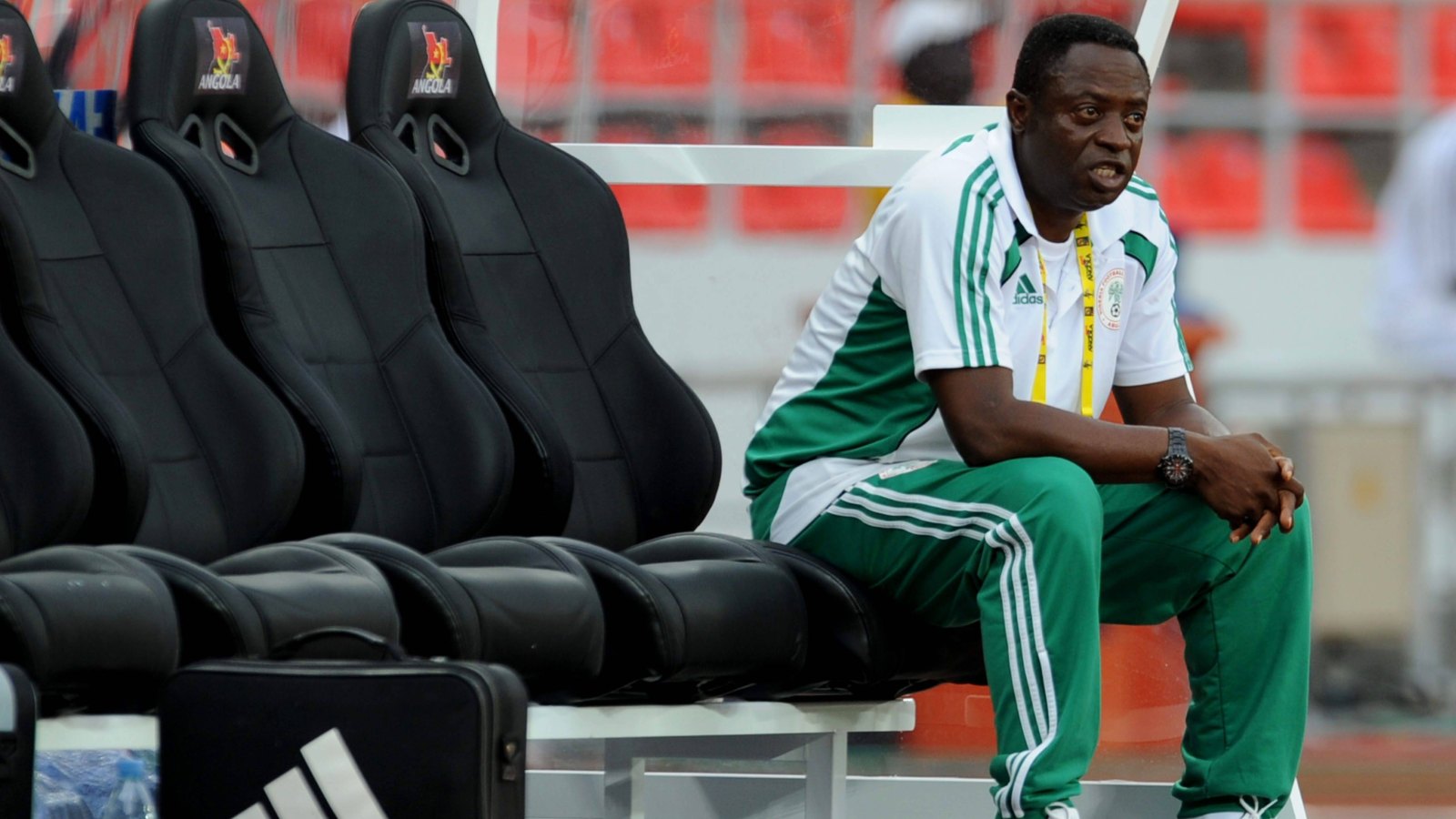
In the early hours of Saturday 11 June 2016, family members in Benin City went to check on Shuaibu Amodu and found him dead in his sleep. He was 58. The night before, after dropping fellow coach Godwin Izilien in the city, he had complained of chest pain, ThisDay reported. Stephen Keshi had died in the same city only days earlier.
Nigeria lost two national team coaches inside a week. Amaju Pinnick, then NFF president, called it “another tragedy too many” and said he was short of words.
| Born | 18 April 1958 |
| Died | June 2016, Benin City, aged 58 |
| Buried | Okpella, Etsako East, Edo State |
| Super Eagles spells | 1994 to 1995, 1998 to 1999, 2001 to 2002, 2008 to 2010 |
| World Cups qualified for | 2002 and 2010, sacked before both |
| Nations Cup | Third place in 2002 and 2010 |
| Club highlight | African Cup Winners' Cup with BCC Lions, 1990 |
| Last post | NFF Technical Director |
Gboko, Maiduguri and Soweto
Before the Eagles, there was BCC Lions of Gboko. Amodu, a former striker whose playing days with Niger Tornadoes ended with a broken leg, built his name on the Benue side, winning the African Cup Winners' Cup in 1990 and reaching the final again in 1991, when Zambia's Power Dynamos beat them 5-4 on aggregate. At home he was the man for the FA Cup. Obituaries from ThisDay and the BBC credited him with wins in 1989, 1992, 1993 and 1994, more than any other coach in the competition's history, plus a league and cup double in 1994 and three Super Cups. He also coached El-Kanemi Warriors of Maiduguri. Then came South Africa. Amodu managed Orlando Pirates from 1996 to 1997. The club's 1995 African Cup of Champions Clubs title came just before him, under Joe Frickleton and his assistant Ronald Mkhandawire.
Four spells and a pattern
He was 36 when he first took the national team in 1994, succeeding Clemens Westerhof after the golden generation had won the Nations Cup in Tunisia. That first stint ended in 1995. He returned in 1998, again in 2001, and again in April 2008.
The 2001 campaign showed the job he was usually handed. He came in mid-campaign and steered Nigeria to the top of the group, sealing it on 29 July 2001 in Port Harcourt, where Victor Agali scored in the first minute and Tijani Babangida added two in a 3-0 win over Ghana.
Eight years later the finish was even tighter. On 14 November 2009 at Kasarani in Nairobi, Obafemi Martins scored twice and Yakubu once in a 3-2 win over Kenya, while Tunisia lost 1-0 in Maputo to Mozambique; Nigeria finished on 12 points to Tunisia's 11 and were going to South Africa.
Two qualifications. Neither ended with him on the bench at a World Cup.
Sacked twice after the job was done
In February 2002, weeks after a third place finish at the Nations Cup in Mali, Sports Minister Ishaya Mark Aku announced that “the technical crew of the team have been dissolved and the national team disbanded.” Festus Onigbinde was named to take a new squad to Korea and Japan. Amodu answered: “I have no regrets. I believe the officials know why they took such a decision.” His assistant that year was Stephen Keshi.
Onigbinde later admitted regrets over some of the players he took.
History repeated itself in 2010. Nigeria lost the Angola semi-final 1-0 to Ghana, then beat Algeria 1-0 in Benguela on 30 January through Obinna Nsofor to finish third again. On 6 February the NFF dismissed him and published a shortlist of foreign replacements. Lars Lagerbäck was appointed on 27 February on a five month contract running through the World Cup, and the 2010 squad left South Africa without a win.
Capital FM noted at the time that the displays in Angola had been widely criticised by the press and the public.
The fireman's last years
He never really left. The NFF named him national Technical Director in May 2013. In October 2014 he was briefly put in charge of the Eagles, until Keshi returned two weeks later. “We have done it before; we will do it again,” he said that October, as Nigeria chased a place at the 2015 Nations Cup.
They did not make it.
In February 2016 the NFF offered him the head coach role again after Sunday Oliseh left. He declined, the federation said, on health grounds linked to hypertension. A month later he told BBC Sport: “I must confess that all is not well with Nigerian football in terms of structure and funding.”
The tributes came quickly. “He was a disciplinarian, father and a mentor,” Elderson Echiejile wrote. Joseph Yobo said his heart bled. Oliseh tweeted: “First Keshi and now this. God help us!” The NFF's statement put it simply: “You can't talk about the history of Super Eagles without Amodu getting prominent chapters.” He was buried that day in Okpella under Islamic rites.
Our view
Shuaibu Amodu was not the most fashionable coach Nigeria ever hired. He was the most reliable at one thing: getting the Super Eagles through qualifying when the campaign looked shaky. The federation treated that skill as disposable.
Twice he was removed after doing what he was hired to do. Neither replacement won a match at the finals.
Nobody can prove Amodu would have done better, and his Nations Cup sides were often hard to watch.
But the way Nigeria treated him, as a fireman to call and then dismiss, says more about the NFF than about him. He deserved a World Cup touchline.
This article was most recently revised and updated 5 seconds ago